
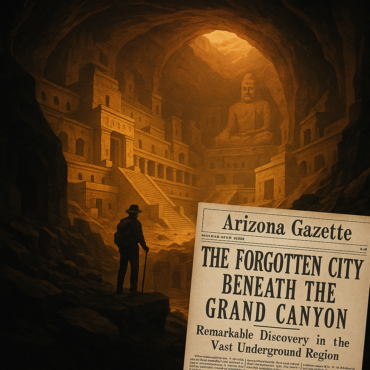
The Forgotten City Beneath the Grand Canyon: Truth, Legend, or Cover-Up?
In 1909, a sensational headline in the Arizona Gazette claimed that an intrepid explorer named G.E. Kincaid had stumbled upon something extraordinary inside the sheer walls of the Grand Canyon — an entire underground city.
According to the story, Kincaid, traveling by boat down the Colorado River, spotted a strange entrance high up in the canyon wall. Upon climbing to it, he allegedly entered a labyrinth of stone-carved tunnels stretching for miles. Inside, he found hieroglyph-covered walls, mysterious statues (including a Buddha-like figure), finely crafted pottery, tools made from an unknown alloy, and even mummified remains. The article boldly suggested that this hidden city could have housed over 50,000 people, hinting at links to ancient Egyptian or Asian civilizations.
The Details That Hooked a Nation
The Gazette claimed Kincaid was working with Professor S.A. Jordan from the Smithsonian Institution, who was leading a full-scale excavation. The alleged findings read like the plot of an adventure novel: vast chambers, storage rooms filled with seeds and grains, intricate irrigation systems, and even a mysterious “shrine room” dominated by a colossal statue.
The implication was explosive — what if advanced civilizations had reached North America thousands of years earlier than mainstream history admits?
So… Where’s the Evidence?
And here’s where the story takes a sharp turn.
No other newspaper ever reported on the discovery. The Smithsonian has officially denied any involvement, stating that there are no records of Kincaid, Jordan, or such an excavation. Modern researchers combing the canyon have found no physical evidence of the site described in the article.
Skeptics point out that the Arizona Gazette piece was never followed up, and its language feels more like early 20th-century pulp fiction than sober journalism. Some historians suspect it was a hoax designed to boost newspaper sales — a common practice in that era.
Why the Legend Won’t Die
Despite the lack of proof, the tale refuses to fade.
Conspiracy theorists claim the government or the Smithsonian covered up the discovery to protect the official historical narrative. Others insist the supposed cave lies within restricted areas of the canyon, making independent verification nearly impossible. Online forums, podcasts, and YouTube channels keep the story alive, feeding a modern audience hungry for “hidden history.”
Science vs. Mystery
From a scientific standpoint, extraordinary claims require extraordinary evidence — and so far, the “forgotten city” offers none. Geologists note that the Grand Canyon’s geology makes large-scale ancient construction extremely challenging, especially without advanced technology. Archaeologists emphasize that no artifacts matching the description have surfaced in credible excavations.
Yet, there’s a reason the legend is so enduring: the Grand Canyon is home to thousands of caves, many unexplored. Could one of them hold secrets that might rewrite history? Unlikely, perhaps — but not impossible.
Final Thoughts
Whether it’s a masterpiece of early tabloid fiction or the greatest archaeological cover-up of all time, the story of the forgotten city beneath the Grand Canyon taps into something timeless: our fascination with the unknown.
And maybe, just maybe, somewhere behind those sheer red cliffs, a secret still waits to be uncovered.
editor's pick
latest video

news via inbox
Nulla turp dis cursus. Integer liberos euismod pretium faucibua